The Building Of The Ship
"Build me straight, O worthy Master!
Stanch and strong, a goodly vessel,
That shall laugh at all disaster,
And with wave and whirlwind wrestle!
Stanch and strong, a goodly vessel,
That shall laugh at all disaster,
And with wave and whirlwind wrestle!
The merchant's word
Delighted the Master heard;
For his heart was in his work, and the heart
Giveth grace unto every Art.
A quiet smile played round his lips,
As the eddies and dimples of the tide
Play round the bows of ships,
That steadily at anchor ride.
And with a voice that was full of glee,
He answered, "Erelong we will launch
A vessel as goodly, and strong, and stanch,
As ever weathered a wintry sea!"
And first with nicest skill and art,
Perfect and finished in every part,
A little model the Master wrought,
Which should be to the larger plan
What the child is to the man,
Its counterpart in miniature;
That with a hand more swift and sure
The greater labor might be brought
To answer to his inward thought.
And as he labored, his mind ran o'er
The various ships that were built of yore,
And above them all, and strangest of all
Towered the Great Harry, crank and tall,
Whose picture was hanging on the wall,
With bows and stern raised high in air,
And balconies hanging here and there,
And signal lanterns and flags afloat,
And eight round towers, like those that frown
From some old castle, looking down
Upon the drawbridge and the moat.
And he said with a smile, "Our ship, I wis,
Shall be of another form than this!"
It was of another form, indeed;
Built for freight, and yet for speed,
A beautiful and gallant craft;
Broad in the beam, that the stress of the blast,
Pressing down upon sail and mast,
Might not the sharp bows overwhelm;
Broad in the beam, but sloping aft
With graceful curve and slow degrees,
That she might be docile to the helm,
And that the currents of parted seas,
Closing behind, with mighty force,
Might aid and not impede her course.

In the ship-yard stood the Master,
With the model of the vessel,
That should laugh at all disaster,
And with wave and whirlwind wrestle!
Covering many a rood of ground,
Lay the timber piled around;
Timber of chestnut, and elm, and oak,
And scattered here and there, with these,
The knarred and crooked cedar knees;
Brought from regions far away,
From Pascagoula's sunny bay,
And the banks of the roaring Roanoke!
Ah! what a wondrous thing it is
To note how many wheels of toil
One thought, one word, can set in motion!
There's not a ship that sails the ocean,
But every climate, every soil,
Must bring its tribute, great or small,
And help to build the wooden wall!
The sun was rising o'er the sea,
And long the level shadows lay,
As if they, too, the beams would be
Of some great, airy argosy.
Framed and launched in a single day.
That silent architect, the sun,
Had hewn and laid them every one,
Ere the work of man was yet begun.
Beside the Master, when he spoke,
A youth, against an anchor leaning,
Listened, to catch his slightest meaning.
Only the long waves, as they broke
In ripples on the pebbly beach,
Interrupted the old man's speech.
Beautiful they were, in sooth,
The old man and the fiery youth!
The old man, in whose busy brain
Many a ship that sailed the main
Was modelled o'er and o'er again;--
The fiery youth, who was to be
the heir of his dexterity,
The heir of his house, and his daughter's hand,
When he had built and launched from land
What the elder head had planned.

"Thus," said he, "will we build this ship!
Lay square the blocks upon the slip,And follow well this plan of mine.
Choose the timbers with greatest care;
Of all that is unsound beware;
For only what is sound and strong
To this vessel stall belong.
Cedar of Maine and Georgia pine
Here together shall combine.
A goodly frame, and a goodly fame,
And the UNION be her name!
For the day that gives her to the sea
Shall give my daughter unto thee!"
The Master's word
Enraptured the young man heard;And as he turned his face aside,
With a look of joy and a thrill of pride,
Standing before
Her father's door,
He saw the form of his promised bride.
The sun shone on her golden hair,
And her cheek was glowing fresh and fair,
With the breath of morn and the soft sea air.
Like a beauteous barge was she,
Still at rest on the sandy beach,
Just beyond the billow's reach;
But he
Was the restless, seething, stormy sea!
Ah, how skilful grows the hand
That obeyeth Love's command!
It is the heart, and not the brain,
That to the highest doth attain,
And he who followeth Love's behest
Far excelleth all the rest!
Thus with the rising of the sun
Was the noble task begun
And soon throughout the ship-yard's bounds
Were heard the intermingled sounds
Of axes and of mallets, plied
With vigorous arms on every side;
Plied so deftly and so well,
That, ere the shadows of evening fell,
The keel of oak for a noble ship,
Scarfed and bolted, straight and strong
Was lying ready, and stretched along
The blocks, well placed upon the slip.
Happy, thrice happy, every one
Who sees his labor well begun,
And not perplexed and multiplied,
By idly waiting for time and tide!
And when the hot, long day was o'er,
The young man at the Master's door
Sat with the maiden calm and still,
And within the porch, a little more
Removed beyond the evening chill,
The father sat, and told them tales
Of wrecks in the great September gales,
Of pirates coasting the Spanish Main,
And ships that never came back again,
The chance and change of a sailor's life,
Want and plenty, rest and strife,
His roving fancy, like the wind,
That nothing can stay and nothing can bind,
And the magic charm of foreign lands,
With shadows of palms, and shining sands,
Where the tumbling surf,
O'er the coral reefs of Madagascar,
Washes the feet of the swarthy Lascar,
As he lies alone and asleep on the turf.
And the trembling maiden held her breath
At the tales of that awful, pitiless sea,
With all its terror and mystery,
The dim, dark sea, so like unto Death,
That divides and yet unites mankind!
And whenever the old man paused, a gleam
From the bowl of his pipe would awhile illume
The silent group in the twilight gloom,
And thoughtful faces, as in a dream;
And for a moment one might mark
What had been hidden by the dark,
That the head of the maiden lay at rest,
Tenderly, on the young man's breast!

Day by day the vessel grew,
With timbers fashioned strong and true,
Stemson and keelson and sternson-knee,
Till, framed with perfect symmetry,
A skeleton ship rose up to view!
And around the bows and along the side
The heavy hammers and mallets plied,
Till after many a week, at length,
Wonderful for form and strength,
Sublime in its enormous bulk,
Loomed aloft the shadowy hulk!
And around it columns of smoke, upwreathing.
Rose from the boiling, bubbling, seething
Caldron, that glowed,
And overflowed
With the black tar, heated for the sheathing.
And amid the clamors
Of clattering hammers,
He who listened heard now and then
The song of the Master and his men:--
"Build me straight, O worthy Master.
Staunch and strong, a goodly vessel,
That shall laugh at all disaster,
And with wave and whirlwind wrestle!"
Staunch and strong, a goodly vessel,
That shall laugh at all disaster,
And with wave and whirlwind wrestle!"
With oaken brace and copper band,
Lay the rudder on the sand,
That, like a thought, should have control
Over the movement of the whole;
And near it the anchor, whose giant hand
Would reach down and grapple with the land,
And immovable and fast
Hold the great ship against the bellowing blast!
And at the bows an image stood,
By a cunning artist carved in wood,
With robes of white, that far behind
Seemed to be fluttering in the wind.
It was not shaped in a classic mould,
Not like a Nymph or Goddess of old,
Or Naiad rising from the water,
But modelled from the Master's daughter!
On many a dreary and misty night,
'T will be seen by the rays of the signal light,
Speeding along through the rain and the dark,
Like a ghost in its snow-white sark,
The pilot of some phantom bark,
Guiding the vessel, in its flight,
By a path none other knows aright!
Behold, at last,
Each tall and tapering mast
Is swung into its place;
Each tall and tapering mast
Is swung into its place;
Long ago,
In the deer-haunted forests of Maine,
When upon mountain and plain
Lay the snow,
They fell,--those lordly pines!
Those grand, majestic pines!
'Mid shouts and cheers
The jaded steers,
Panting beneath the goad,
Dragged down the weary, winding road
Those captive kings so straight and tall,
To be shorn of their streaming hair,
And, naked and bare,
To feel the stress and the strain
Of the wind and the reeling main,
Whose roar
Would remind them forevermore
Of their native forests they should not see again.
And everywhere
The slender, graceful spars
Poise aloft in the air,
And at the mast-head,
White, blue, and red,
A flag unrolls the stripes and stars.
Ah! when the wanderer, lonely, friendless,
In foreign harbors shall behold
That flag unrolled,
'T will be as a friendly hand
Stretched out from his native land,
Filling his heart with memories sweet and endless!
All is finished! and at length
Has come the bridal day
Of beauty and of strength.
To-day the vessel shall be launched!
With fleecy clouds the sky is blanched,
And o'er the bay,
Slowly, in all his splendors dight,
The great sun rises to behold the sight.
The ocean old,
Centuries old,
Strong as youth, and as uncontrolled,
Paces restless to and fro,
Up and down the sands of gold.
His beating heart is not at rest;
And far and wide,
With ceaseless flow,
His beard of snow
Heaves with the heaving of his breast.
He waits impatient for his bride.
There she stands,
With her foot upon the sands,
Decked with flags and streamers gay,
In honor of her marriage day,
Her snow-white signals fluttering, blending,
Round her like a veil descending,
Ready to be
The bride of the gray old sea.
On the deck another bride
Is standing by her lover's side.
Shadows from the flags and shrouds,
Like the shadows cast by clouds,
Broken by many a sunny fleck,
Fall around them on the deck.
Is standing by her lover's side.
Shadows from the flags and shrouds,
Like the shadows cast by clouds,
Broken by many a sunny fleck,
Fall around them on the deck.

The prayer is said,
The service read,
The joyous bridegroom bows his head;
And in tears the good old Master
Shakes the brown hand of his son,
Kisses his daughter's glowing cheek
In silence, for he cannot speak,
And ever faster
Down his own the tears begin to run.
The worthy pastor--
The shepherd of that wandering flock,
That has the ocean for its wold,
That has the vessel for its fold,
Leaping ever from rock to rock--
Spake, with accents mild and clear,
Words of warning, words of cheer,
But tedious to the bridegroom's ear.
He knew the chart
Of the sailor's heart,
All its pleasures and its griefs,
All its shallows and rocky reefs,
All those secret currents, that flow
With such resistless undertow,
And lift and drift, with terrible force,
The will from its moorings and its course.
Therefore he spake, and thus said he:--

"Like unto ships far off at sea,
Outward or homeward bound, are we.
Before, behind, and all around,
Floats and swings the horizon's bound,
Seems at its distant rim to rise
And climb the crystal wall of the skies,
And then again to turn and sink,
As if we could slide from its outer brink.
Ah! it is not the sea,
It is not the sea that sinks and shelves,
But ourselves
That rock and rise
With endless and uneasy motion,
Now touching the very skies,
Now sinking into the depths of ocean.
Ah! if our souls but poise and swing
Like the compass in its brazen ring,
Ever level and ever true
To the toil and the task we have to do,
We shall sail securely, and safely reach
The Fortunate Isles, on whose shining beach
The sights we see, and the sounds we hear,
Will he those of joy and not of fear!"
Then the Master,
With a gesture of command,
Waved his hand;
And at the word,
Loud and sudden there was heard,
All around them and below,
The sound of hammers, blow on blow,
Knocking away the shores and spurs.
And see! she stirs!
She starts,--she moves,--she seems to feel
The thrill of life along her keel,
And, spurning with her foot the ground,
With one exulting, joyous bound,
She leaps into the ocean's arms!

And lo! from the assembled crowd
There rose a shout, prolonged and loud,
That to the ocean seemed to say,
"Take her, O bridegroom, old and gray,
Take her to thy protecting arms,
With all her youth and all her charms!"
There rose a shout, prolonged and loud,
That to the ocean seemed to say,
"Take her, O bridegroom, old and gray,
Take her to thy protecting arms,
With all her youth and all her charms!"
How beautiful she is! How fair
She lies within those arms, that press
Her form with many a soft caress
Of tenderness and watchful care!
Sail forth into the sea, O ship!
Through wind and wave, right onward steer!
The moistened eye, the trembling lip,
Are not the signs of doubt or fear.
She lies within those arms, that press
Her form with many a soft caress
Of tenderness and watchful care!
Sail forth into the sea, O ship!
Through wind and wave, right onward steer!
The moistened eye, the trembling lip,
Are not the signs of doubt or fear.
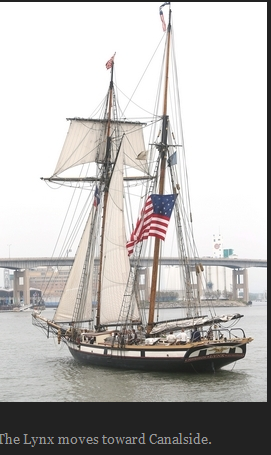
Sail forth into the sea of life,
O gentle, loving, trusting wife,
And safe from all adversity
Upon the bosom of that sea
Thy comings and thy goings be!
For gentleness and love and trust
Prevail o'er angry wave and gust;
And in the wreck of noble lives
Something immortal still survives!
O gentle, loving, trusting wife,
And safe from all adversity
Upon the bosom of that sea
Thy comings and thy goings be!
For gentleness and love and trust
Prevail o'er angry wave and gust;
And in the wreck of noble lives
Something immortal still survives!

Thou, too, sail on, O Ship of State!
Sail on, O UNION, strong and great!
Humanity with all its fears,
With all the hopes of future years,
Is hanging breathless on thy fate!
We know what Master laid thy keel,
What Workmen wrought thy ribs of steel,
Who made each mast, and sail, and rope,
What anvils rang, what hammers beat,
In what a forge and what a heat
Were shaped the anchors of thy hope!
Fear not each sudden sound and shock,
'T is of the wave and not the rock;
'T is but the flapping of the sail,
And not a rent made by the gale!
In spite of rock and tempest's roar,
In spite of false lights on the shore,
Sail on, nor fear to breast the sea
Our hearts, our hopes, are all with thee,
Our hearts, our hopes, our prayers, our tears,
Our faith triumphant o'er our fears,
Are all with thee,--are all with thee!

Henry Wadsworth Longfellow
SOURCE~~~~~~~~~~~~~~David M. Shribman: ‘The Building of the Ship’
Longfellow’s classic poem inspired statesmen and reads especially well on Memorial Day
May 24, 2015 12:00 AM
Longfellow’s classic poem inspired statesmen and reads especially well on Memorial Day
May 24, 2015 12:00 AM
By David M. Shribman / Pittsburgh Post-Gazette
---{-=@
Hickok