Wednesday, April 1, 2015


Astronaut begins U.S. history-making mission


IMAGE!!!!!!!!

Successful liftoff launches NASA’s planned longest-ever manned mission


(CNN)NASA astronaut Scott Kelly has started a trip to the record books.
He plans to spend 342 days on the International Space Station -- the longest stretch of time any U.S. astronaut has spent in space.
Kelly lifted off Friday aboard a Russian Soyuz rocket that launched from Kazakhstan. The rocket docked at the ISS at 9:33 p.m. ET, according to a tweet from NASA, with hatches between the Soyuz and the space station scheduled to open about 11:15 p.m. ET.
Kelly will stay twice as long as any U.S. astronaut has ever stayed on the space station, giving scientists a chance to study how the human body responds to long-duration space flights. On Earth, scientists will perform parallel studies on Scott Kelly's identical twin brother, retired astronaut Mark Kelly.
"It's a lot of fun," Kelly said at a media briefing in January. "Space station is a magical place."
Two cosmonauts are riding up with Kelly: Mikhail Kornienko and Gennady Padalka. Kornienko also will stay up for a year. Padalka will only stay up for six months.
The trio will join three crew members already on the space station: U.S. astronaut Terry Virts, Russian cosmonaut Anton Shkaplerov and Italian astronaut Samantha Cristoforetti. Other crew members also will rotate in and out during their year in orbit so it will never be just Kelly and Kornienko on the station.
Kelly, 51, hopes to break the record for the longest mission on the space station set by NASA astronaut Michael Lopez-Alegria and Russian cosmonaut Mikhail Tyurin. They spent over seven months on the ISS -- from September 18, 2006, to April 21, 2007. 


Outer space guinea pig

He is expected to spend 342 days off the planet on this mission. When added to his previous space missions, that would give him a total of 522 days in space, breaking the record of U.S. astronaut Mike Fincke. Fincke spent a combined 381 days, 15 hours and 11 minutes in space, according to his official NASA bio.
While Kelly shoots to set space station and other U.S. records, Padalka is on schedule to set a record for the most total time in space for a human. He's already spent more than 710 days in space, including stays on Russia's Mir space station and three previous stints on the International Space Station.
Why do it? Why stay up on the station so long?
NASA wants to know more about the impact of long-duration spaceflights on the human body to help plan missions to Mars and deeper into space. And the space station, in orbit 250 miles above Earth, is the best place available to study that.
Spending that much time in a weightless environment will take a toll. NASA says space station astronauts have vision changes, bone loss, muscle atrophy and other problems.
NASA says the experiments should have benefits on Earth, such as helping patients recover from long periods of bed rest to improved monitoring of people whose bodies are unable to fight infections.

Twin brother part of the experiments, too

The space station has about the same living space as a six-bedroom, two bathroom house. And it has a 360-degree bay window with a great view. But astronauts and cosmonauts still report feeling isolated and confined at times. Kelly will document his feelings about being away from his two children and the rest of his family.
"I'm going to keep a personal journal of the experience," Kelly said. He also will share some of his journal with researchers studying the psychological impacts of long-term space flight. Will he tell all?
"I plan to be completely honest about it," he said, but ... "who knows, maybe there are some crazy thoughts I'll have at the end that I wouldn't want to share."


Mark Kelly has volunteered for NASA's "Twins Study" to see how the identical twins change over the year in two very different environments. He is the husband of former U.S. Rep. Gabrielle Giffords of Arizona, who left office after being wounded in a January 2011 assassination attempt.
"He thinks it's great that he can still be a participant in this," Scott Kelly said.
So Mark will be on Earth getting poked and prodded by researchers -- while Scott makes history in orbit.
 View image on Twitter   

Scott Kelly (left) and his twin, former astronaut Mark Kelly, in 2008.      

Scott Kelly (left) and his twin, former astronaut Mark Kelly, in 2008.

--{-=@

HICKOK


Tuesday, March 31, 2015

Tuesday, March 31, 2015~~~~~NEW YORK TIMES IMAGE!!!!!!!!


Successful liftoff launches NASA’s planned longest-ever manned mission


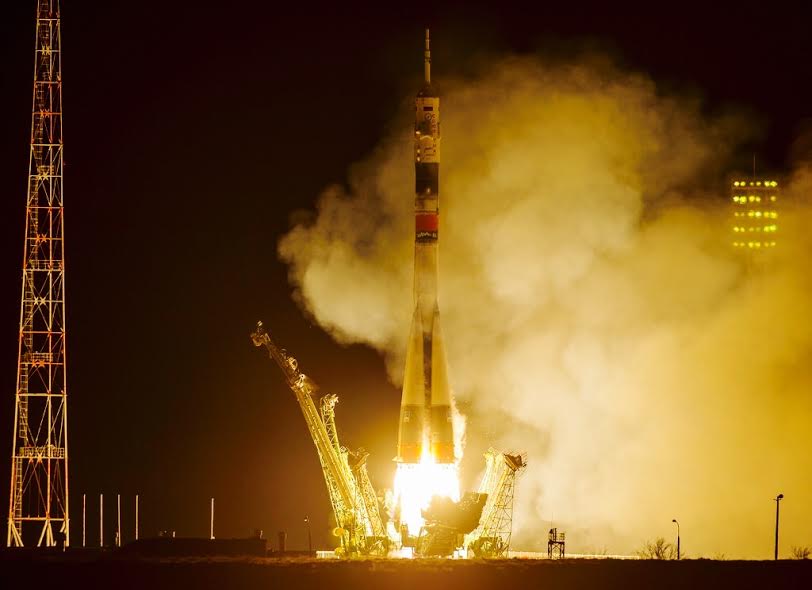
The Soyuz TMA-16M spacecraft is seen as it launches to the International Space Station with Expedition 43’s NASA Astronaut Scott Kelly and Russian cosmonauts Mikhail Kornienko and Gennady Padalka of the Russian Federal Space Agency (Roscosmos) onboard Friday, March 27 (Saturday, March 28 Kazakh time) from the Baikonur Cosmodrome in Kazakhstan. Credit: NASA/Bill Ingalls


The first ever ‘One-Year Mission’ to the International Space Station (ISS) started with a bang today, March 27, with the spectacular night time launch of the Russian/American crew from the Baikonur Cosmodrome in Kazakhstan at 3:42 p.m. EDT Friday (1:42 a.m., March 28 in Baikonur and culminated with a flawless docking this evening.

NASA astronaut Scott Kelly and Russian cosmonauts Mikhail Kornienko and Gennady Padalka launched aboard a Soyuz TMA-16M spacecraft to the International Space Station precisely on time today on the Expedition 43 mission.
The crew rocketed to orbit from the same pad as Russia’s Yuri Gagarin, the first human in space.
Kelly and Kornienko will spend about a year living and working aboard the space station on the marathon mission. Padalka will remain on board for six months.


The goal is to use the massive orbiting outpost to provide critical knowledge to NASA and researchers hoping to better understand how the human body reacts and adapts to long-duration spaceflight and the harsh environment of space.
The pathfinding mission is about double the normal time of most expeditions to the Earth orbiting space station, which normally last four to six months.
The one-year mission is among the first concrete steps to start fulfilling NASA’s “Journey to Mars” objective of sending “Humans to Mars” in the 2030s.
“Scott Kelly’s mission is critical to advancing the administration’s plan to send humans on a journey to Mars,” said NASA Administrator Charles Bolden, in a statement.
“We’ll gain new, detailed insights on the ways long-duration spaceflight affects the human body.”


---{-=@

HICKOK

Successful liftoff launches NASA’s planned longest-ever manned mission


Along with Russian cosmonaut Mikhail Kornienko, Kelly will spend nearly a full year aboard the International Space Station. That's close to the record time spent in space (14 months undertaken in 1994 on the Russian Mir station) and the longest anyone has spent in space since then. It's also going to break the record for the longest time spent on the International Space Station, and Kelly will break NASA's spaceflight length record by about five months.

At the Baikonur Cosmodrome (the world's oldest launch facility), U.S. astronaut Scott Kelly and Russian cosmonaut Mikhail Kornienko will board a Soyuz rocket and hitch a ride to the International Space Station. Once there, they'll stay for about 340 days. That's the longest anyone has ever stayed at the ISS by nearly five months, and the longest anyone has been in space since 1994, when Valeri Polyakov spent 14 months on the now defunct Mir.

To add to the excitement, Kelly's twin (Mark Kelly, a retired astronaut) has volunteered to spend his year being poked and prodded as much as his space-bound brother will be. Scientists across the country submitted research proposals in hopes of taking advantage of this twin study data, and the 10 selected experiments will examine how spaceflight affects everything from gut bacteria to DNA expression.

Cosmonaut Gennady Padalka also launched with Kornienko and Kelly, though he'll only spend the standard six months aboard ISS before returning to Earth. But Padalka, who's made three trips to ISS and spent time on Russia's now-defunct Mir station, is breaking a record as well: He's spent more than 710 days in space already, and once he finishes his current jaunt, he'll have broken the world record (currently held by Sergei Krikalev with 803 days) for total time spent off the Earth.
Kelly and his crewmates should reach ISS about 9:30 p.m. ET.


Soon we'll be flying a rocket-powered, saucer-shaped test of #LDSD. Learn about it March 31 at noon ET. Details: http://go.nasa.gov/1HdJhgL


NASA's Kennedy Space Center·
In case you missed the coverage of Friday night’s Soyuz TMA-16M spacecraft launch from the Baikonur Cosmodrome in Kazakhstan, here’s another view. The Soyuz TMA-16M spacecraft launched to the International Space Station with Expedition 43 NASA astronaut Scott Kelly, Russian cosmonauts Mikhail Kornienko and Gennady Padalka of the Russian Federal Space Agency (Roscosmos) onboard. As the ‪#‎YearInSpace‬ crew, Kelly and Kornienko will return to Earth on Soyuz TMA-18M in March 2016.


...got 10-out-of-12-right.

Congratulations! You got all or most of these questions right, proving yourself a true expert on the US Air Force.
quizpug.com

Lou Marconi ...the nuns rolling in the portable-TV-platforms


Lou Marconi


Monday, March 30, 2015

A Successful Launch to the International 


Space Station~~~~~~PART III

A dedication web-log posting


Scott Kelly, a NASA astronaut, is the first American to make a one-year trip to space. He arrived at the International Space Station Friday with two Russians, Mikhail Kornienko, who will also remain in space for a year, and Gennady Padalka, who will stay for only six months but is on track to break the record for the most cumulative time a human has spent in  space — nearly two and a half years.  


 AN  ESSAY~~~~~~~~~~~~


The Art of The Deception;
The Soviet's ability to, for so long, give the West the Perception of their space-race dominance.

Vanise Leal and  like this.   


  • Leana Elam You should hear the Fox Folks, they are making it sound like Iran is about to bomb us out. Either or - i wonder who will be the first. Enjoy each day for it may be our last.....

  • Lou Marconi The above is the Russian Soyuz-FG rocket with Soyuz TMA-10M spacecraft aboard. This rocket has been the mainstay of the Soviet/Russian manned-space-programs---since 1967!!!!

  • Lou Marconi Since 1967!!

 Lou Marconi While the above configuration is the ONE-BOOSTER rocket, with 4 ""strap-ons""" ---- the cumulative package amounting to 20 booster-rocket engine nozzles, and 12 vernier-rocket nozzles ---- the APPEARANCE of foreboding space-dominance is evident. The Soviets, with their mythical images of space dominance had the WEST further confounded by the compounded curiosity of what really did STAR CITY; The Baikonur Cosmodrome in Kazakhstan, Russia-----where all of the manned-launches took place----really look like??
  • Lou Marconi This Russian Soyuz-FG rocket ~~~~ has the power-pack of 940,000 lbs of thrust----at lift-off.

  • Lou Marconi Impressive~~but~~~~~not so fast
  •  
      

    Lou Marconi ATTACHED is a GRAPHIC of size, shape, and nozzle configuration of the most notable rockets of the US & Russian manned space programs.

    • Lou Marconi While the Russian Soyuz-GF rocket APPEARS to be formidable, ~IT EVENTUALLY MEETS ITS MATCH!!
    • Lou Marconi Right through the middle-1960's, the US Manned Space Program is still BEHIND the Soviets---and their formidable Russian Soyuz-GF rocket. At this point our successes are resting on our TITAN II rocket which is used to get the Gemini capsules in orbit. The first-stage thrust power of the TITAN II is only 300,000 lbs, at lift-off.
    • Lou Marconi THEN~~~~comes our 1967!!!
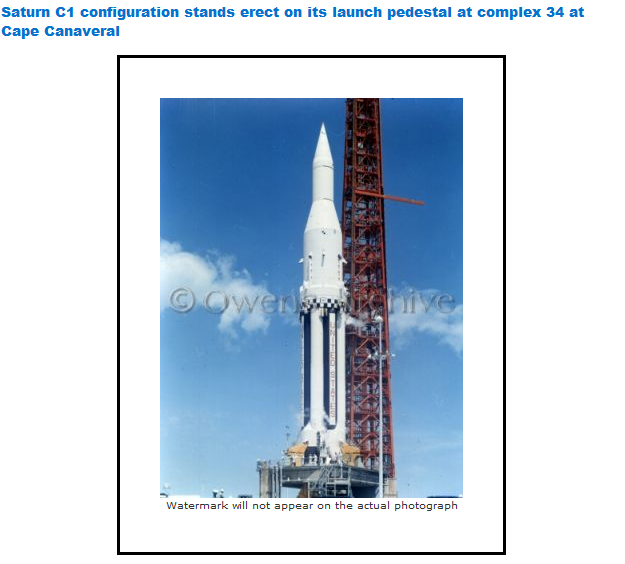
       Lou Marconi Our Saturn C-1B


      Lou Marconi Eight Rocketdyne H-l engines provide a total thrust of 1.6 million pounds---at lift-off
                                  

      • Lou Marconi Eight Rocketdyne H-l engines ~~~~ not 20; with 12 verniers of the Soviet-Mystique-Missile ~~~~ Eight Rocketdyne H-l engines ---- giving 1.6 million pounds of thrust, compared to the mythical Russian Soyuz-GF rocket with the output of only 940,000 lbs of thrust.
      • Lou Marconi AND THEN~~~~CAME THE GRAND-DADDY~~~~~OF THEM ALL!!!!


  •                                                                                                                      
       ...with just~~~~~~~~~~~~~~~~5-First-Stage-Nozzles
                              

    • Lou Marconi The SATURN C-5 rocket redefined "massive," standing 363 feet (110 meters) in height and producing a ludicrous 7.68 million pounds of thrust from the five monstrous, kerosene-gulping Rocketdyne F-1 rocket engines that made up its first stage.
      • Lou Marconi ~~~~I thought that you in particular----would appreciate this broad brush-stroke explanation of how the rocketry used by the two super-powers, and the respective visual-imagery that accompanied the propaganda, can have such an impact----on perceptions.
      • Lou Marconi ...at this~~~~ALMOST~~~~all day.
      • Lou Marconi Leana Elam~~~~they may~~~~we have ABDICATED. Fold the PENTAGON~~~~dissolve the Department of Defense.
      • Victor Marconi Lou, you know your history
        Wow...really eye opening! Thank you for the time and effort in revealing these facts....GOOD JOB Louie! I guess it was the mystique that had me assume they had something greater than anything we had!
        • Lou Marconi!!! Yes!!! I was sucked-in, too!!! I mean----look at the IMAGE---that sets-up this dissertation, for God's sake. The damned thing LOOKS-LIKE it could send 10 cosmonauts---to Pluto---and have them back in time---for The Stanley-Cup-Finals----THIS YEAR!!
          ---{-=@
          HICKOK